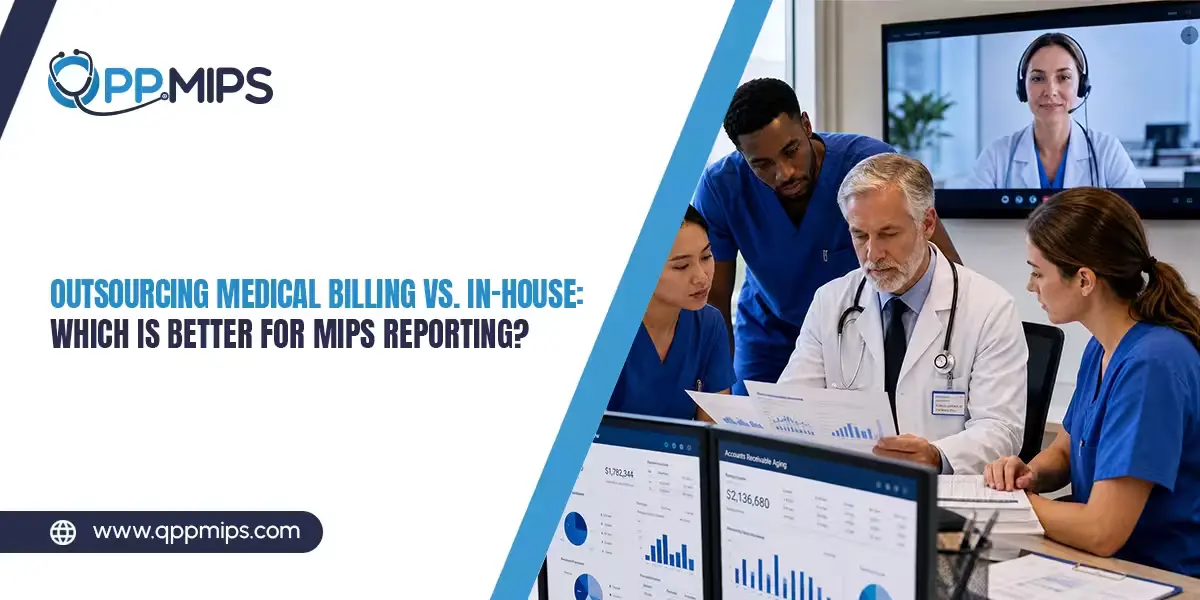
The Merit-based Incentive Payment System (MIPS) remains a critical financial hurdle for healthcare providers in 2026. With the performance threshold by AMA locked at 75 points, clinicians are essentially walking a tightrope: achieve this benchmark to avoid a 9% reduction in Medicare Part B reimbursements, or potentially earn an incentive payment for exceeding it.
For many practices, the struggle is about the administrative burden of reporting across four performance categories: Quality, Cost, Promoting Interoperability, and Improvement Activities. The decision to manage this reporting in-house or via an outsourced billing partner is no longer just a budgetary choice but has become a strategic decision that impacts long-term practice viability.
Understanding the MIPS Landscape
MIPS success is fundamentally built on data integrity. Because CMS uses specific metrics like eCQMs (electronic clinical quality measures) and MIPS CQMs to score performance, the precision of your clinical documentation is paramount.
Practices must meet a 75% data completeness threshold for all denominator-eligible cases. Whether your team is internal or external, they serve as the frontline for capturing the data required for these measures. If the coding is inconsistent or the documentation is incomplete, you risk failing to capture the full scope of your quality efforts, leading to lower scores regardless of the actual care provided.
In-House Billing: Control and Continuity
Managing billing internally allows for a high degree of operational proximity.
The Pros
- Direct Oversight: You maintain real-time visibility into the revenue cycle. If a specific measure is underperforming, you can pull a chart immediately for correction.
- Customization: Internal teams can adapt quickly to the unique workflows of your specific specialty or sub-specialty requirements.
- Security: Sensitive patient health information (PHI) remains entirely within your local network infrastructure.
The Challenges
- Fixed Overhead: You carry the full burden of salaries, benefits, software licenses, and IT infrastructure, regardless of fluctuating patient volumes.
- Compliance Drift: Keeping an internal team trained on evolving CMS (Center of medicare and Medicaid Services) rules and ICD-10 updates is a constant, resource-heavy necessity.
- Risk of Turnover: The loss of one key billing specialist or coder can create a knowledge vacuum that jeopardizes your entire MIPS reporting timeline.
Outsourced Billing: Efficiency and Expertise
Outsourcing shifts the administrative burden to firms like QPP MIPS who specialize in regulatory compliance and revenue cycle management.
The Pros
- Scalability: Costs typically align with your revenue rather than remaining static, providing financial predictability as your practice grows.
- Regulatory Specialization: Outsourced teams are dedicated to tracking CMS rule changes, which reduces the likelihood of reporting errors and audit exposure.
- Focus on Care: By offloading complex billing and MIPS data capture, clinical teams can reclaim their time and focus on patient outcomes rather than administrative paperwork.
The Challenges
- Loss of Transparency: Relying on third-party reporting can create a transparency gap where the practice loses direct insight into why claims or reporting metrics are delayed.
- Communication Lag: Friction can occur between the practice’s clinical staff and the external billing partner if documentation handoffs are not clearly defined.
- Hidden Costs: Setup fees and contractual nuances can add up, making it vital to review the total cost of ownership before signing.
The Role of Technology: EHR Interoperability
Your EHR is the primary source of truth for MIPS performance data. Regardless of whether you use an in-house team or an outsourced partner, your success depends on how seamlessly your technology connects with your billing infrastructure.
Why Integration Matters
- Data Integrity: MIPS scoring relies on specific metrics like eCQMs. If your EHR and billing software are siloed, you create reporting blind spots. True interoperability ensures clinical data flows automatically into your billing and reporting workflows, ensuring complete data capture.
- Reduced Burden: Disconnected workflows force staff to manually bridge the gap between clinical notes and claim submissions. Fully integrated systems track MIPS performance in real-time, allowing you to address gaps in care well before submission deadlines.
Evaluating Your Strategy
- In-House Billing: You maintain direct access to data, but you must ensure your team is proficient in using your EHR’s specific MIPS-certified functionalities. The main risk is software that lacks the automation necessary to keep pace with CMS reporting requirements.
- Outsourced Billing Services: The risk is a data handoff bottleneck. You must verify that your partner uses Certified Electronic Health Record Technology (CEHRT) capable of pulling data directly from your system via secure APIs. Without this, you risk data degradation and increased audit exposure.
Red Flags: When It’s Time to Reconsider Your Billing Model
Choosing between an in-house team and an outside partner isn’t a one-time decision. If you notice these warning signs, your current setup may be holding your practice back:
- Last-Minute Panic: If you spend the end of the reporting period scrambling to fix errors, your system isn’t keeping up. You should be tracking performance year-round, not panicking at the deadline.
- Rising Claim Denials: A high number of rejected claims is a major red flag. It shows that communication between your clinic and your billing team is breaking down, which directly hurts your revenue and MIPS scores.
- Knowledge Vacuum Risk: If your entire billing process relies on one or two people, you are vulnerable. If a key employee leaves, does your billing grind to a halt? If yes, you lack the safety net a professional firm provides.
- Administrative Overload: Is your team buried in paperwork instead of patient care? If administrative tasks are pulling your staff away from the exam room, it is time to simplify your workflow.
- Lack of Transparency: You should never have to wait days for an update on your MIPS progress. If you feel in the dark about your practice’s performance, you need a more transparent partner.
Which Path Should You Choose?
The right model often depends on the practice’s current growth stage and digital maturity.
- Size and Volume: Smaller practices often find that outsourcing provides the professional-grade infrastructure they could not otherwise afford at scale. Large groups may find the overhead of an in-house team justifiable due to the volume of data and the need for deep, practice-specific integration.
- Technology Integration: Modern hybrid models are becoming common, where practices like QPP MIPS use specialized billing platforms or automation software to handle the heavy lifting of MIPS reporting, allowing either an in-house or outsourced team to oversee the process more efficiently.
- Performance Benchmarking: Regardless of the model, you must track KPIs such as first-pass claim rates, denial rates, and days in A/R. If your current model shows a denial rate consistently above 12–15%, your MIPS reporting is likely suffering from the same underlying data quality issues.
Conclusion
MIPS success is ultimately about accurate, consistent data management, not just the physical location of your billing team. The best approach is the one that minimizes your compliance risk while maximizing your team’s ability to prioritize patient care.
As we look toward the future, the lines between these models are blurring. Advanced automation and AI-driven revenue cycle management (RCM) tools are increasingly available to both in-house teams and outsourced partners. The key to staying ahead is not choosing In-House or Outsourced in a vacuum, but rather selecting the partner or internal framework that best aligns with your practice’s long-term strategy for quality performance.
Stop risking your Medicare reimbursements.
Whether you need to optimize your in-house team or transition to an expert partner, QPP MIPS provides the data-driven support to keep you audit-ready and profitable.
Contact Billing Experts today
FAQs
- Is outsourced medical billing better than in-house billing for MIPS reporting?
Outsourced medical billing can improve MIPS reporting by providing compliance expertise, accurate data management, and support with evolving CMS requirements.
- What are the main differences between in-house and outsourced billing for MIPS success?
In-house billing offers control and customization, while outsourcing provides specialized expertise, scalability, and reduced administrative workload for practices.
- How does medical billing impact MIPS performance scores?
Accurate billing, coding, and documentation directly affect MIPS scores by ensuring complete data capture and preventing reporting errors.
- Can outsourcing medical billing help reduce MIPS compliance risks?
Yes, experienced billing partners help practices manage CMS updates, improve reporting accuracy, and reduce risks related to compliance gaps.
- Should healthcare practices switch from in-house billing to outsourcing for MIPS reporting?
The right choice depends on practice size, workflow needs, technology systems, and ability to manage MIPS reporting requirements effectively.